Wildlife · 8 min read
The Great Migration: Where the Herds Are Each Month
The migration is not an event with a date. It is a continuous 800-kilometre loop, and knowing where it is decides where you should sleep.
The short answerThe Great Migration is a year-round loop, not an event. January to March the herds calve on the southern Serengeti plains around Ndutu; April and May they move north-west through the central Serengeti; June brings the Grumeti crossings; July to October the herds are in the northern Serengeti crossing the Mara River; November and December they sweep back south with the short rains.
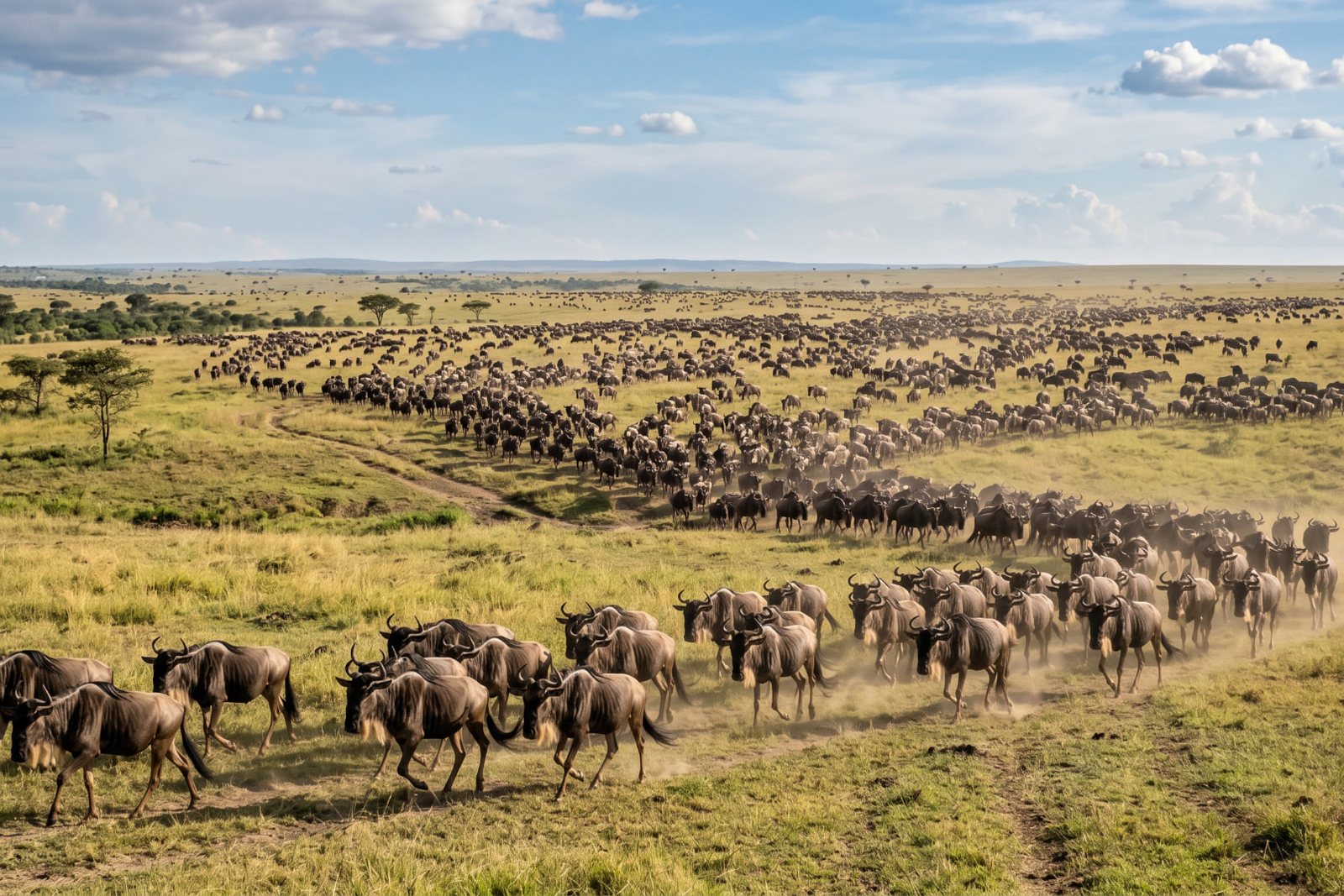
Around 1.5 million wildebeest, 250,000 zebra and hundreds of thousands of gazelle move clockwise through the Serengeti–Mara ecosystem, following rainfall and fresh grass. The herds never stop, so 'seeing the migration' is really a question of positioning your camp in the right sector for your dates.
December to March — Ndutu and the southern plains
Volcanic soils in the south produce mineral-rich short grass, ideal for nursing mothers. The herds arrive in December and calve from late January through February. Predator density here in February is as high as anywhere on earth.
April and May — the central and western Serengeti
As the long rains fall, the herds drift north-west in long columns through the Moru kopjes towards the western corridor. Rutting season begins in May and the noise of half a million wildebeest at dusk is unforgettable.
June — the Grumeti River
The first serious water obstacle. Crossings on the Grumeti are less famous than the Mara but just as dramatic, and the resident crocodiles here are enormous. Far fewer vehicles come this way.
July to October — the Mara River in the north
This is the crossing everyone pictures. Herds mass on the southern bank, hesitate, and then pour across. Crossings are unpredictable — some days there are three, some days none — so plan at least two nights in the north if this is your goal.
November — moving south again
The short rains pull the herds back down through the eastern and central Serengeti, and by December the loop is closing on the southern plains again.
Two honest warnings
- ·The migration follows rain, not calendars. Shifts of two to three weeks either way are normal.
- ·River crossings cannot be guaranteed by any operator. Anyone who guarantees one is selling you something they do not control.

About the author
Isaac Sumary
Isaac is a Tanzanian safari guide from Arusha and the founder of both the Fruitful Orphanage & Day Care Center and Fruits & Love Safaris. He has been driving the northern circuit for over a decade, and 10% of every safari payment goes back to the children in his care. Reach him on +255 762 353 576 or isaacsumary@yahoo.com.
Planning a trip?
We run private safaris from Arusha and give 10% of every payment to the Fruitful Orphanage. Send us your dates and we will reply within 24 hours with a quote in USD.
Get a quote